
Interpreting is usually the last line item added to an event budget and the first thing people complain about when a session goes badly. That order is worth reversing, because almost everything that determines whether interpreting services for a multilingual conference work well is decided weeks before anyone steps into a booth.
Six things drive the decision: the shape of your agenda, the number of languages in the room, the delivery format you need, and the size of the interpreter team your program requires. They are connected. Change one and you change the others.
This guide sets out those decisions in the order they have to happen, shows what a real quote requires from you, and gives you a booking timeline to work backward from.
What Makes a Multilingual Conference Different from a Single-Language Event?
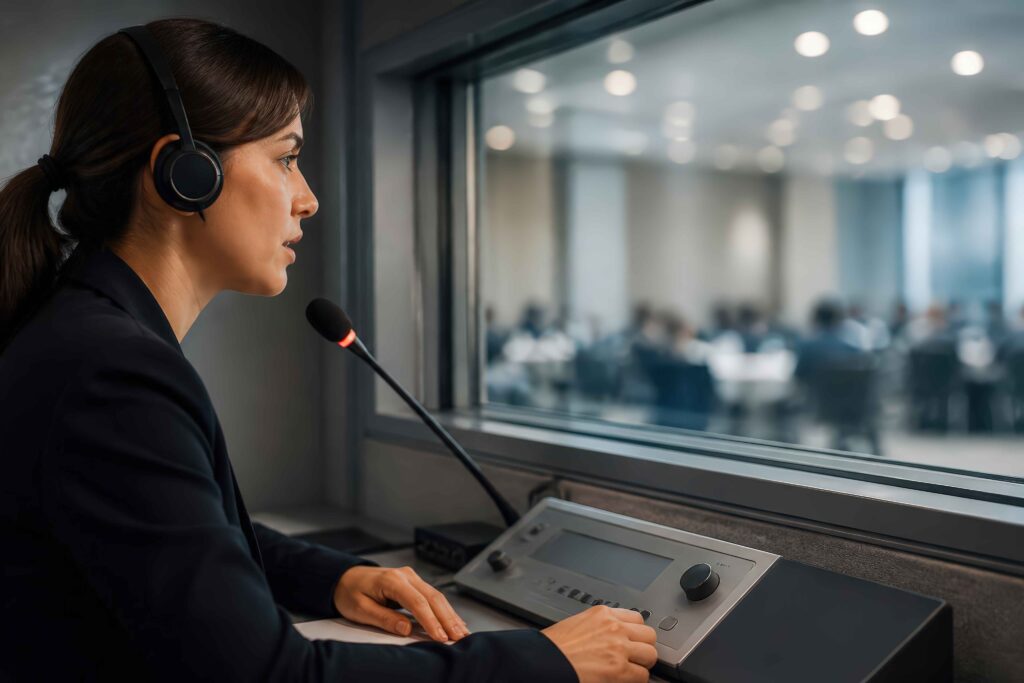
A multilingual conference differs from a regular one because interpretation adds a delivery chain between the speaker and the listener. The speaker, microphone, interpreter, transmitter, receiver, and the delegate’s own ear all have to hold for a single sentence to arrive intact.
The people in the room experience it differently too. A delegate on a language channel hears a voice a few seconds behind the stage, so they laugh late, applaud late, and look up at a slide after the speaker has moved past it. They cannot see who is speaking to them. They lose the room’s reaction as a cue and rely entirely on what reaches the headset.
That gap changes decisions that look unrelated to language. Room capacity stops being about seats and starts being about booth space and sightlines. Moving two sessions into the same slot stops being a scheduling tweak, because it doubles your interpreter count. Ordinary planning decisions quietly become language decisions, which is why they have to be made in a particular order.
The Six Decisions for Choosing Conference Interpreting Services For a Multilingual Conference
These six decisions run in a fixed order, because each one depends on the answer above it. Work out of sequence and you re-quote.
1. Your Agenda Sets Your Language List
Start by mapping the agenda session by session, noting the format, language requirements, and whether sessions run concurrently.
Read the Program session by session
A conference is rarely one event. It is a plenary, a set of breakouts, a few workshops, a panel with floor questions, maybe a site visit and an evening function. Each format places different demands on interpreters. A scripted keynote and an open floor debate are different jobs.
Concurrency is where budgets get surprising. Three breakout rooms running at the same time in two languages is not one assignment. It is three, each with its own team and its own equipment. This is a common mid-planning discovery, and it tends to arrive after the budget has been signed off.
Note: which sessions are recorded or streamed. That affects consent and contract terms, and it needs settling early.
Count language pairs from registration data
Audience languages and speaker languages are two different lists. A delegate who reads English comfortably may still follow a dense technical presentation only in their first language.
Registration data is your evidence. Language requests collected at signup carry more weight than assumptions about which regions are attending, and they give a provider something concrete to quote against.
Relay, and Why it Changes your Booth Count
When no interpreter works directly between two languages, one booth interprets into a common language and the other booths work from that feed. This is relay, and it is standard practice at large multilingual events.
It costs a small delay and one more point of failure. Every language downstream depends on the pivot booth, so if that booth loses audio, several channels go quiet at once. Ask your provider which booth is the pivot and what the fallback is.

2. Your Languages and Session Formats Set the Mode
Mode follows the format of each room. It is not one decision made for the whole event, and most conferences end up using more than one of the interpreting services.
Simultaneous Interpreting
Simultaneous interpretation is the most common mode of interpretation for a conference. The interpreter works in real time while the speaker keeps talking, and attendees listen on a receiver or a channel on their own device.
This is the default for plenaries, keynotes, and any session where pausing would break the flow. It is also the only mode that supports relay, so if your language list needs a pivot booth, those sessions have to run simultaneously.
Simultaneous equipment, either a booth and receivers onsite or a platform for remote delivery, which is why choosing it immediately constrains decision 3.
Capital Linguists Can Also Help With Standalone Simultaneous Interpretation Services.
Consecutive Interpreting
The speaker pauses, the interpreter delivers the segment, then the speaker continues. Minimal equipment, though the interpreter is taking notes throughout rather than working from memory alone, so they need a position near the speaker and somewhere to write.
The European Commission’s guidance on consecutive interpreting sets it out as a three-stage process of listening, analysing, and delivering. It suits press interviews, small negotiations, award presentations, and short bilateral meetings.
Whispered Interpreting and tour-guide systems
When one or two delegates need a different language, an interpreter can work quietly beside them. For walking tours, factory visits, and site inspections, a portable transmitter and headsets do the job.
These setups are inexpensive and mobile, and they have real limits. A portable system in a large hall with poor acoustics will disappoint everyone using it.
Sign language Interpreting
Sign language is a language requirement in its own right. Plan it into the language list at the same time as spoken languages, and budget for two interpreters per session, since signing carries the same fatigue load as spoken simultaneous work and teams rotate for the same reason.
Practical details matter more than most organizers expect. Interpreters need clear sightlines to the stage, consistent lighting, and a position that keeps them and the presentation screen in the same field of view. Captioning works alongside sign language interpreting rather than in place of it, since some attendees rely on one and some on the other.
Language access for events also carries a legal dimension in the US. The Department of Justice sets out the effective communication requirements that apply to public entities and businesses open to the public, including qualified interpreters and real-time captioning. Requirements elsewhere vary, so confirm what applies in your jurisdiction.
Sight Translation
Agendas, notices, and one-page handouts sometimes appear mid-session with no translated version. An interpreter can read the document and deliver it orally. This is sight translation, and it is intended for immediate understanding in the room. Anything an attendee will keep, sign, or refer to later should be translated in writing before the event
3. Your Modes and Venue Set the Delivery Format
Before you can budget for interpretation, you need to know how it will be delivered. Onsite booths, remote platforms, and hybrid setups each ask something different about your venue, your AV team, and your timeline.
Onsite with Booths
Interpreters work from soundproof booths with a direct view of the stage. This gives you the best control over audio and the fastest response when something breaks, and it remains standard for high-stakes and press-facing sessions.
The cost side is real: booths, consoles, receivers, technicians, travel, and per diems.
Remote Simultaneous Interpretation (RSI)
Interpreters work offsite through a platform, and attendees select a language channel on their own device. Remote simultaneous interpretation suits virtual conferences, webinars, and multi-city meetings, and it removes travel from the budget. It also widens the pool for rare language combinations, where the available interpreters may be nowhere near your venue.
Remote delivery changes what you need from the venue. The constraint moves from booth space to bandwidth.
Hybrid, and the Audio Chain
Hybrid causes the most trouble, and the cause is almost always audio. Interpreters can only interpret what they can hear. A room microphone four meters from the speaker, an audience question asked without a mic, or a laptop speaker feeding back: any of these degrades the interpretation before the interpreter has done anything.
Latency is the second issue. When the in-room feed and the remote feed drift apart, remote attendees start responding to points the room has already passed.
What goes wrong in the first fifteen minutes is rarely the platform. It is a roaming Q&A microphone nobody tested, or a speaker who steps away from the lectern to point at a slide. Both are fixable in advance, and neither gets checked unless someone owns the problem.
Assign one technical contact who owns the audio chain from microphone to interpreter to attendee. When responsibility is split across venue AV, platform vendor, and interpreting provider, a problem becomes nobody’s problem.
4. Everything Above Sets Your Team Size
Once your languages, concurrent rooms, and delivery format are settled, team size is arithmetic rather than judgment.
How many Interpreters do you need Per language?
Organizers ask about team size first, and the answer is at least two interpreters per language for simultaneous work, rotating throughout the session.
The reason is cognitive load. Listening, analyzing, and speaking at once stays accurate for roughly 20 to 30 minutes before it slips. The off-duty interpreter stays in the booth and notes numbers, names, and difficult terms for the colleague who is working, which is how booth partners work to keep accuracy up across a long session.
| Setup | Booths | Interpreters |
|---|---|---|
| One language, one room, one day | 1 | 2 |
| Three languages, one room, one day | 3 | 6 |
| Three languages, three concurrent rooms, one day | 9 | 18 |
| Any of the above with dense technical content or relay | Same | Add one per booth |
If those numbers are higher than you expected, the fix is almost always the agenda rather than the language list. Consolidating interpreted sessions into fewer concurrent rooms cuts the middle row’s cost by two thirds without dropping a single language.
What do A-language and B-language mean on a provider’s roster?
An A-language is the interpreter’s native or strongest language. A B-language is one they work into at a professional standard without it being native.
Providers plan assignments around that distinction, and it shapes which combinations can share a booth. Working into a B-language is normal professional practice, but you can ask that particular sessions be staffed A only. For a technical plenary, a press-facing panel, or anything where a misread number carries consequences, that request is reasonable and a conference interpreting provider should be able to accommodate it or explain why not.
Which Credentials Should you Check?
Conference interpreter qualifications start with training, and a postgraduate qualification in conference interpreting is the usual benchmark. Professional association membership is a useful signal, as is court or federal certification when the program touches legal content, and healthcare credentials when it touches clinical material.
Subject-matter experience is the piece organizers skip most often. An excellent interpreter with no background in your sector will still struggle with a dense technical panel unless materials reach them early, which is why the prep materials covered under Briefing Your Provider are not optional.
5. Your Team and Delivery Format Set Your Equipment
Every interpreter you booked needs somewhere to work and a clean signal to work from, and that requirement drives the rest of your equipment list.
What Does an Onsite Setup Include?
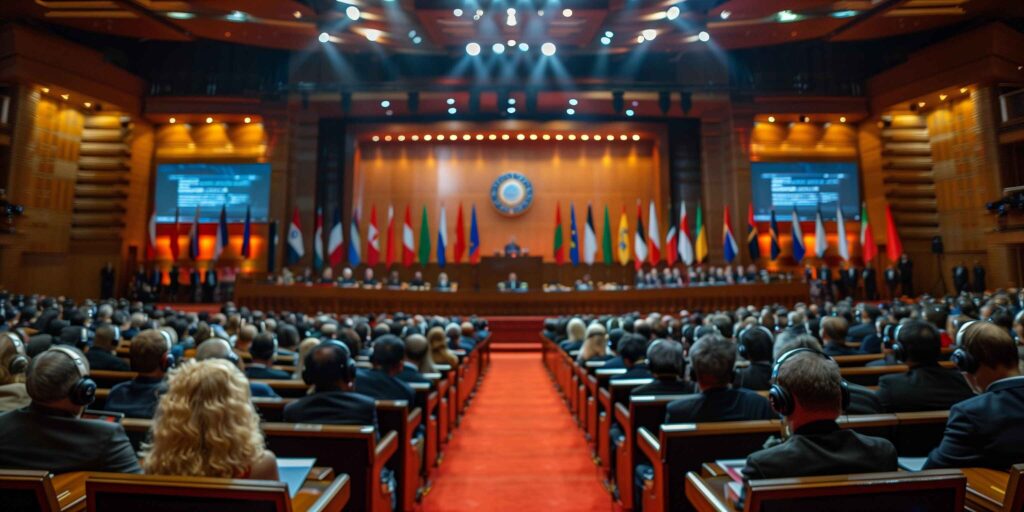
A working setup includes booths, interpreter consoles, transmitters, receivers and headsets, speaker microphones, and a distribution system. It also includes a technician, onsite the day before for setup and sound check, and reachable throughout the event.
Receiver quantities catch people out. Order one per attendee who will use interpretation, plus 10 to 15 percent spares for flat batteries and units that go missing between sessions.
Booth placement deserves attention. Interpreters need a direct line of sight to the speaker and screens, positioned away from noise sources.
If your venue has no permanent booths, confirm who is supplying the interpreting equipment the room needs, including mobile booths, consoles, receivers, and headsets.
What does your venue have to confirm?
Power supply, internet bandwidth, load-in access, ceiling height, and room acoustics all shape what is possible. Confirm early whether the venue’s in-house AV team will hand over a clean audio feed, and on what terms. That conversation is easier eight weeks out than on setup day.
What Should an RSI platform Support?
Start with the number of simultaneous language channels supported, and confirm it covers your full language list rather than most of it.
Then the interpreter side: audio fidelity, clean handover between interpreters, a video feed of the speaker, and a backup route if a connection drops. Then the attendee side, where switching language should take one tap and someone should explain how before the first session.
6. Your Equipment Choice Sets Your Booking Deadline
This is the step most planning guides leave out. Your deadline is not a generic industry rule. It comes from whatever you decided in step 4.
Mobile booths and receivers are physical inventory. A regional supplier holds a finite number of booths and a finite number of receivers, and conference season empties both. If your setup needs four booths and 600 receivers, you are competing with every other event in the region for the same stock. Book earliest.
Permanent booths remove the inventory problem but add a venue problem. You are now booking a specific room, and a room change after equipment is confirmed means a new equipment plan.
RSI moves the deadline from hardware to people and rehearsal. No booths to ship, but you still need platform capacity for your full channel count, interpreters cleared on that platform, and a dry run with real speakers.
Rare language combinations are the hardest constraint of all, because there may be only a handful of qualified interpreters for your pair worldwide, whatever equipment you use.
The booking Calendar
Work backward from your event date. Each milestone has a consequence attached, which is what makes it worth hitting.
| When | Do this | If you miss it |
|---|---|---|
| 8 to 12 weeks out | Confirm languages, agenda, and venue, then book interpreters and equipment | You choose from who is available, not who is right for your content |
| 4 to 6 weeks out | Confirm run of show, room assignments, and recording plans | Room changes now mean equipment changes |
| 7 to 10 days out | Send prep materials and glossaries | This is the window where quality is decided |
| 1 day out | Equipment setup, sound check, platform dry run | Faults surface live instead of in rehearsal |
| Event day | Sound check before doors open, technical contact on call | — |
Briefing Your Provider
Most advice on this topic gives you questions to ask a vendor. The more common failure runs the other way: organizers send a thin brief, receive a price built on assumptions, and find the gap when the invoice arrives.
The information a real quote needs
Send these six things:
- The full agenda, with session formats and times
- Your language list, with the registration evidence behind it
- Room count, and which sessions run concurrently
- Venue name with an AV contact, or the platform you plan to use
- Which sessions are recorded, streamed, or distributed afterward
- Any accessibility requirements, including sign language and captioning
A provider quoting without these is pricing a generic day rather than your event.
What their Answers Should Tell You
Read the response as a diagnostic. Strong providers give you numbers with reasoning attached; weak ones give you numbers.
On team size, a good answer names interpreters per language and explains why that number fits your program. On credentials, it describes sector experience relevant to your content. On event staffing, it names a person and a phone number rather than a department.
Ask what the equipment or platform price includes and what is billed separately, how relay is handled if you add a language, and what happens if an interpreter or connection fails. Get cancellation, overtime, and change terms in writing, and settle recording and distribution rights before signing. References from comparable events are reasonable to ask for and easy for a real provider to supply.
If a provider cannot answer the relay question or name the technical contact, that tells you more than any price comparison.
Prep Materials, and the Seven-Day Rule
Send the final agenda, slide decks, scripts, speaker bios, acronym lists, product names, and any glossary you already use. Aim for 7 to 10 days ahead, then forward updates as they happen.
Late slides are the most common cause of avoidable errors. An interpreter seeing a technical diagram for the first time on stage is working without the preparation the job requires.
Confidentiality and Recording Rights
Ask about NDAs, secure file transfer, and what happens to materials afterward. Professional interpreters are bound by confidentiality as a matter of professional ethics, and a provider should be able to explain their process without hesitation.
Recording rights deserve their own conversation. If the interpretation will be recorded, streamed, or distributed later, that is a separate permission and often a separate fee.
Brief Your Speakers
A short note to presenters changes the outcome more than most technical fixes. Ask them to speak at a measured pace, use the microphone, and say each acronym in full the first time. If a speech is read from a script, that script needs to reach the booth beforehand.
Build interpretation time into Q&A, because every exchange passing through two languages runs long.
What You Are Actually Paying For
The four multipliers
Interpreting cost is largely a multiplication, not a menu:
languages × concurrent rooms × days × interpreters per booth
Three languages across three concurrent rooms for two days is not “three languages.” At two interpreters per language per room, that is 18 interpreter-days plus the equipment for nine room-language combinations, before travel. The same three languages consolidated into one room for two days is 12 interpreter-days and three room-language combinations.
That single restructuring is usually the largest saving available to an organizer, and it costs nothing but agenda design.
Everything around the Multipliers
Equipment or platform fees, technicians, travel, per diems, overtime, and rights for recording and later distribution. Ask which of these are inside the quoted figure and which are billed after the event.
Where you can cut without hurting quality
- Consolidate multilingual sessions into fewer rooms rather than spreading them across the venue
- Use RSI for sessions that do not need booths
- Book early, since rush bookings and last-minute travel carry premiums
- Trim the language list to what your registration data supports
Contract terms worth reading twice
Check half-day and full-day thresholds, cancellation windows, and change fees. These clauses are what turn a comfortable budget into an uncomfortable one.
Confidentiality and recording rights
Check half-day and full-day thresholds, cancellation windows, and change fees. These clauses are what turn a comfortable budget into an uncomfortable one.
Where Multilingual Events go Wrong
Most failures are visible in advance, either in the provider’s proposal or in the organizer’s own planning.
Warning signs in a proposal:
- A flat per-hour quote produced with no questions asked
- One interpreter offered for a full day of simultaneous work
- No named technical contact anywhere in the document
- Vague answers about who owns the recording of an interpreted session
Mistakes organizers make:
- Treating interpreting as an AV line item rather than a language service
- Sending slides the night before
- Ignoring floor audio quality at hybrid events
- Forgetting Q&A, networking sessions, and the gala dinner
- Adding a language two weeks out and expecting no change in cost
Conclusion
Your agenda is the starting point for every interpreting decision. It sets the mode, the mode sets the equipment, the equipment sets your deadline, and the language list sets how many interpreters each room needs.
Preparation is where quality is won or lost. Materials sent a week ahead will do more for your event than any last-minute upgrade.
Book Conference Interpreters With Capital Linguists
At Capital Linguists, we provide experienced conference interpreters and interpreting and AV equipment for onsite, remote, and hybrid events in more than 200 languages.
Share your agenda, your language list, your venue or platform, and the sessions that need coverage. We will size the interpreter team, confirm the equipment each room requires, and come back with a plan built around your program.

