
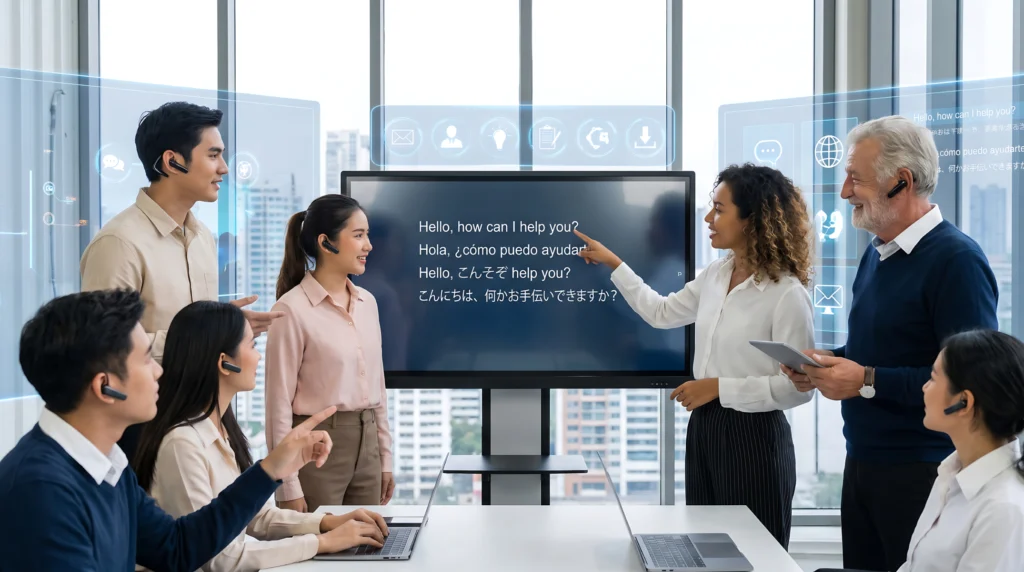
Multilingual business meetings are a regular part of doing business in New York. Companies work with international clients, employees, investors, vendors, and business partners who may feel more comfortable communicating in languages other than English.
That reflects the city itself. According to New York City’s 2026 Newest New Yorkers report, 48% of residents aged five and older speak a language other than English at home, and about 1.78 million residents are considered to have limited English proficiency. That diversity is reflected across New York’s workforce, client base, and business networks.
Even someone who speaks conversational English may find a detailed contract, financial presentation, technical discussion, or negotiation difficult to follow. Before the meeting, you need to know which languages attendees need, how interpretation will work, which documents require translation, and how participants will access interpreted discussion. Planning these details early helps everyone understand the discussion and participate fully.

Why Multilingual Meetings Need Early Planning
Language differences can affect much more than basic understanding. During business discussions, participants may need to follow numbers, deadlines, contract terms, technical descriptions, questions, and changes to proposals. Missing one important detail can change how someone understands the discussion.
This matters most in meetings involving:
- Contracts and agreements
- Financial information
- Compliance requirements
- Technical subjects and product specifications
- Legal matters
- Negotiations
- Business strategy
When participants lack the language support they need, they may misunderstand a statement or hesitate to ask questions. Discussions may also take longer because information has to be repeated or clarified.
Early planning gives you more options. You can determine which languages are needed, select an interpretation format, confirm interpreter availability, prepare translated materials, and test equipment before attendees arrive.
The level of preparation depends on the event. A small client meeting may need a simple setup. A conference involving several languages, hundreds of attendees, and multiple presentations requires much more planning.
In either case, the meeting format should shape the language plan from the start rather than interpretation being added at the last minute.
What to Prepare For A Multilingual Business Meeting In New York

1. Before the Meeting
a. Identify Attendees’ Language Needs
Start by finding out which languages your participants actually need. Rather than basing the decision on where attendees come from, ask which language they prefer to use during professional discussions. Someone may communicate comfortably in English during casual conversation but prefer interpretation when discussing contracts, finances, regulations, or technical information.
Before booking interpreters, confirm:
- Which languages participants speak
- Their preferred language for the meeting
- How many people need interpretation
- How many languages will be used
- Which sessions require interpretation
- Whether attendees will participate in person or remotely
- How complex the subject matter is
Meeting size and format matter as well. A private discussion between three executives has different requirements from a 200-person conference with attendees listening in four languages.
Also consider how much participants will speak. If most attendees are listening to presentations, simultaneous interpretation may make sense. If two parties will be discussing and responding directly to one another, consecutive interpretation may be easier to manage.
Collecting this information first helps you choose a setup that fits the meeting instead of paying for equipment or services you do not need.
2. Choose the Right
No single interpretation method fits every business meeting. The right option depends on the number of attendees, languages, meeting length, level of interaction, venue, and schedule.
a. Consecutive interpretation
Consecutive interpretation works well when a meeting depends on direct, back-and-forth discussion between participants who speak different languages. The speaker talks for a short section and then pauses while the interpreter delivers that part of the message in the other language.
This approach works well when participants need to speak directly with one another, such as in:
- Client meetings
- Business negotiations
- Interviews and consultations
- Small group discussions
- Executive meetings
It also requires less equipment than simultaneous interpretation. In a small meeting room, the interpreter can often sit or stand close to the participants.
The main tradeoff is time. Because each section is spoken and then interpreted, a discussion you would normally schedule for 30 minutes may need considerably longer.
b. Simultaneous interpretation
With simultaneous interpretation, the interpreter listens and interprets while the speaker continues talking. The presenter does not need to stop.
This makes it well suited to:
- Conferences and large corporate meetings
- Seminars and presentations
- Training sessions
- Multilingual panels
- Company-wide events
Participants typically listen through headsets or dedicated language channels. Depending on the venue and event size, the setup may include interpreter booths, consoles, microphones, transmitters, receivers, and other audio equipment. That means it requires more technical planning than consecutive interpretation.
Interpreters need clear access to the speaker’s audio and often a clear view of the stage, presentation screen, or video feed.
The number of languages also affects complexity. A meeting requiring only Spanish interpretation has a much simpler audio setup than an international conference running several language channels.
c. Remote interpretation
Remote interpretation allows interpreters to support a meeting without being physically present at the venue.
It can be consecutive or simultaneous, depending on the platform and meeting format, and works well for:
- Virtual meetings and webinars
- Hybrid events
- International team calls
- Remote client discussions
- Meetings involving attendees in several locations
With remote interpretation, technology becomes a central part of the plan. Interpreters need reliable access to meeting audio, and participants need to know how to select their preferred language channel if the platform supports separate channels.
3. Brief Your Interpreters in Advance
An interpreter can prepare far more effectively when you provide context before the meeting. Start with the agenda. It tells the interpreter who will speak, which subjects will be discussed, how the meeting will progress, and where difficult terminology may appear.
You should also share relevant materials, such as:
- Presentation slides and speaker notes
- Reports
- Contracts
- Product information
- Technical documents
- Materials from previous meetings
If the discussion includes specialized language, create a terminology list covering product names, company names, employee names, industry terms, abbreviations, acronyms, and technical vocabulary speakers are likely to use.
Tell the interpreter what the meeting is trying to accomplish as well. A contract negotiation requires different preparation from a product demonstration or employee training session.
Advance access gives interpreters time to research unfamiliar terms and understand how specific terminology will be used. Avoid sending important documents only minutes before the meeting.
4. Prepare Translated Documents and Presentations
Live interpretation solves only part of the communication problem. Participants may also need written materials in their preferred language.
Review everything attendees will need before, during, and after the meeting, then decide which documents should be translated.
These may include:
- Agendas
- Presentation slides and handouts
- Contracts and forms
- Instructions
- Reports
- Meeting summaries
Keep terminology consistent between translated documents and the interpreted discussion. If your company uses a particular translation for a product, department, or technical term, share it with both your translators and interpreters.
Review completed translations before distributing them. Pay particular attention to names, figures, dates, product terminology, and formatting.
Send the materials early enough for attendees to review them before the meeting rather than seeing them for the first time during the discussion.
5. Test Interpretation Equipment and Meeting Technology
Technology can determine how well participants follow a multilingual meeting. For in-person events, test the microphones, interpretation headsets, receivers, transmitters, and every language channel being used. The European Commission also publishes standards and guidance for interpreting facilities, including requirements for interpreting booths, conference equipment, and meeting-room setups.
Do not test only one headset. Check the system from the participant’s point of view and confirm that the correct language reaches the correct channel.
For simultaneous interpretation, interpreters also need a reliable audio feed from every active microphone..
Virtual and hybrid meetings need the same care. Test:
- Internet connections
- Video conferencing software
- Interpreter access
- Language channels
- Microphones and headsets
- Screen sharing
- Speaker audio
- Participant permissions
When possible, ask remote speakers to use a suitable external microphone instead of relying on weak laptop audio.
A test session with the interpreters before the event can reveal audio or access problems before participants join.
Larger events should also have technical support available. This allows interpreters to focus on interpreting instead of troubleshooting problems with language channels or equipment. Run a final technical check before participants arrive or log in.
1. During the Meeting
a. Help Speakers Communicate Clearly
Good interpretation still depends on clear communication from the speakers. Brief presenters in advance on how the interpreted discussion will work, and ask them to speak clearly at a steady pace. They do not need to speak unnaturally slowly, but rushing through a technical presentation makes interpretation more difficult.
Speakers should also avoid talking over one another, especially during questions, panel discussions, and negotiations.
If several people speak at once, the interpreter cannot follow every speaker accurately. Encourage clear sentences and ask speakers to limit slang, idioms, jokes, and local expressions. These may require additional explanation in another language and can distract from the main point.
When using consecutive interpretation, speakers should pause after manageable sections instead of speaking for several minutes at a time.
Long, uninterrupted answers make it harder for the interpreter to convey every detail accurately. Build enough time into the schedule for questions and clarification.
2. Manage Questions and Audience Participation
For larger meetings, establish a clear process for audience questions. Participants should know which microphone to use, when they can speak, and how interpreted questions will reach the presenter.
Most importantly, make sure interpreters can hear every speaker. A person asking a question from the back of a large room without a microphone may be audible to nearby attendees but difficult for the interpreter to understand.
3. Avoid Common Mistakes in Multilingual Meetings
Many communication problems can be prevented before the meeting starts. One of the most common mistakes is waiting too long to arrange interpretation. Availability can become limited when you need a specific language pair, a subject specialist, or a team of conference interpreters on a particular date.
Another mistake is asking a bilingual employee to interpret a complex discussion simply because they speak both languages.
Being bilingual and interpreting professionally are different skills. Complex negotiations, legal discussions, financial presentations, and technical meetings require careful listening, terminology management, and accurate delivery.
It can also be tempting to rely on automated translation tools for live conversations. These tools may work for informal exchanges, but they can mistranslate figures, legal terms, and industry vocabulary. They may also miss context and tone or provide no practical way to clarify an ambiguous statement in the moment.
For contracts, negotiations, and other high-stakes discussions, those errors can create serious communication problems.
Other avoidable mistakes include:
- Failing to send meeting materials to interpreters
- Giving interpreters no information about technical terminology
- Selecting an interpretation method that does not fit the meeting
- Using microphones with poor audio quality
- Failing to test remote meeting platforms
- Forgetting that several languages may require separate channels
- Assuming conversational English is enough for a complex professional discussion
Multilingual meetings require more preparation than standard business meetings, but most communication problems can be addressed before anyone enters the room.
Conclusion
Multilingual meetings are part of everyday business in New York, and their success depends on preparation. Confirm the languages your attendees need, choose the right interpretation format, brief interpreters early, translate key documents, and test every channel before the meeting begins. These steps cost far less than a misunderstood contract term or a stalled negotiation, and they show participants that their understanding matters.
New York organizations working with multilingual clients, employees, and partners can turn to Capital Linguists for professional interpretation and translation services in New York.
Contact us now.

