
Introduction
Simultaneous interpreting is when an interpreter listens and speaks almost at the same time, so you understand the message in your language while the speaker keeps going.
It’s most commonly used in conferences and large multilingual meetings, which is why it’s often discussed under conference interpreting.
If you are planning a multilingual event or joining one, this guide will help you understand how it works in practice, what equipment is typically involved, and what to avoid so you get clear communication without guesswork.
What is Simultaneous Interpreting?
“Interpreting while the person is speaking, using particular equipment (e.g. booths, earphones, microphone).” — European Commission (DG Interpretation)
Simultaneous interpreting is a form of live interpreting where you hear the message in another language while the speaker continues talking. The interpreter listens, processes meaning, then delivers the target language almost immediately, usually with a short delay of a few seconds.
It is real-time interpreting built around meaning, tone, and intent, not word-for-word output.
It’s designed for uninterrupted communication in settings like conferences, large meetings, and live events where stopping every few sentences would break the flow, which is the key difference from consecutive interpreting, where the speaker pauses so the interpreter can deliver the message in segments.
| Related Article: Consecutive vs Simultaneous Interpretating |
Is Simultaneous Translation the Same as Simultaneous Interpreting?
Yes, in everyday speech people use the terms “simultaneous translation” and “simultaneous interpreting” interchangeably as if they mean the same thing.
In professional language services, they are different: interpreting is live spoken or signed communication delivered while the speaker continues, while translation is written text moved from one language to another.
You will still hear “simultaneous translation” in conferences and live events, and dictionaries list it as a term, which reinforces the habit.
In the industry, it’s widely treated as a misnomer for simultaneous interpreting, because the work is happening with speech in real time, not written text.
How Simultaneous Interpreting Works (step-by-step)
Simultaneous interpreting follows a tight, repeatable loop. It looks simple on paper. In practice, every step happens under pressure, in real time, with almost no room to rewind.
- The speaker talks
The presenter delivers the message at normal speed, with their usual phrasing, tone, and pace. - The interpreter listens and tracks meaning
The interpreter listens for the main idea, the structure, and the details that change meaning, like numbers, names, dates, and intent. - The interpreter reformulates in the target language
The interpreter delivers the message in the listener’s language in a natural sentence order, adjusting for grammar and phrasing so it makes sense as spoken language. - The audience hears it through a language channel
Listeners receive the interpreted audio through headsets, a room audio system, or a remote platform channel, usually a few seconds behind the speaker.
How Interpreters Perform Simultaneous Interpreting
The process of simultaneous interpreting can feel easy for the listener, but the workflow for the interpreter is very different. This is the approach I used on assignments, and it’s a practical way to explain what happens in the booth without overcomplicating it.
- The interpreter tracks the main idea first, then the details that change meaning, like names, numbers, dates, and negatives.
- A few seconds of lag gives enough context to avoid guessing, especially when the key point comes late.
- The interpreter rebuilds the message in natural target-language phrasing so it sounds clear, not literal.
- If the speaker is fast or dense, the interpreter protects the core meaning and critical facts, then compresses repeats.
- The interpreter monitors their output and, in longer sessions, rotates with a partner to keep performance steady.
-
Pro tipHere’s a tip I used constantly during assignments. When a speaker started a long sentence that could twist at the end, I did not chase their grammar. I waited for an “anchor” word that shows the direction of the idea, then I rebuilt the sentence naturally in the target language. If someone opens with “What we cannot accept is…”, I pause for a beat, catch the real point, then deliver it clearly without copying the source structure. |
What Equipment and Setup You Need For A Simultaneous Interpretation
Good audio output in a simultaneous interpretation is linked with the right equipment. If the interpreter can’t hear a clean sound feed, accuracy drops fast.
Here’s the key equipment you need for simultaneous interpreting, based on the most common setup scenarios.
1. On-site (booths, consoles, headsets)
On-site simultaneous interpreting runs on a clear chain. The speaker’s audio feeds the interpreter, the interpreter speaks into a mic, and the audience listens on a language channel through receivers and headsets.
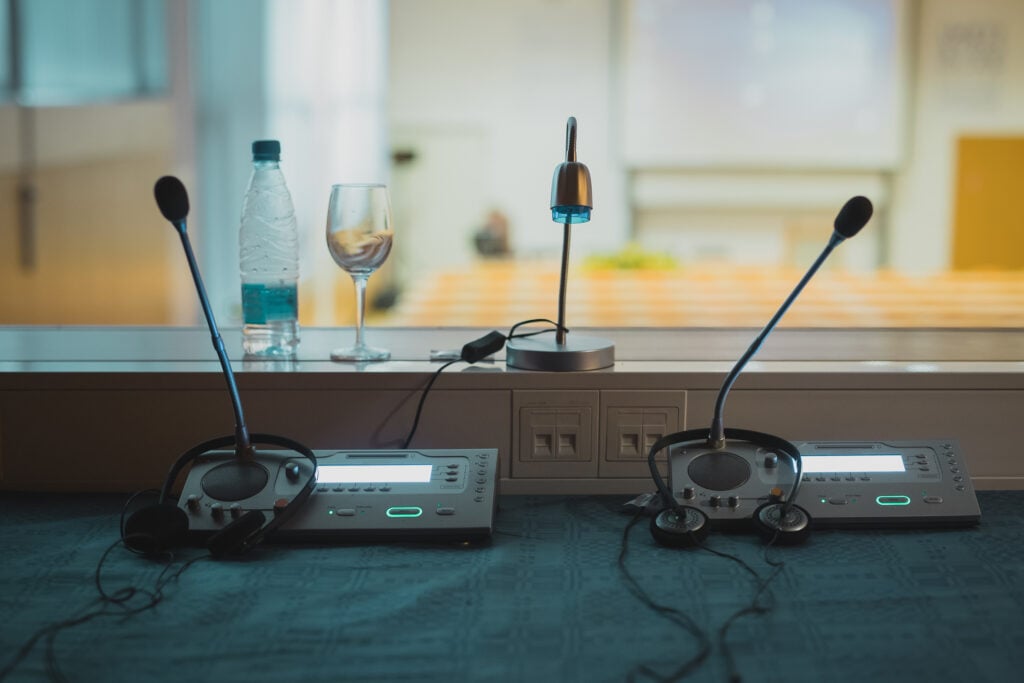
Most setups use an interpreter booth, an interpreter console, dedicated microphones, and receivers/headsets for listeners.
2. Portable Options for Small Rooms
For small meetings, you usually choose between a portable simultaneous system (bidule) and whispered interpreting (chuchotage).
A bidule uses a small transmitter mic for the interpreter and receivers with headsets for listeners, so a group can hear clearly without stopping the speaker.
It suits workshops, site visits, short briefings, and any room where you want a clean audio channel without installing a booth.
Chuchotage works when only one or two people need support and the space is quiet. The interpreter sits close and whispers the message while the speaker continues.
It becomes a poor fit when the group is larger, the room is noisy, or the session runs long, because it strains the interpreter and can distract others.
3.Remote Simultaneous Interpreting (RSI) and Hybrid Events
Remote simultaneous interpreting (RSI) delivers simultaneous interpreting through an online platform, so the interpreter works off-site while participants select a language channel on their device.
It fits webinars, multi-city meetings, and hybrid events where travel, timing, or budget makes on-site booths impractical.
RSI still depends on equipment. Interpreters need a reliable computer, a wired internet connection where possible, a quality headset and microphone, and a quiet space.
Simultaneous Interpretation Common Mistakes (and how to avoid them)
What I’ve seen most often as an interpreter and service provider is that the same issues keep coming up in simultaneous interpreting. Some come from the service setup, others come from event planning decisions.
Here are the most common issues and how you can avoid them.
Issue #1: “We’ll just use one interpreter.”
Simultaneous interpreting is mentally intense. One interpreter working alone will tire quickly, and accuracy drops when fatigue sets in. That’s when omissions and small meaning shifts start to appear.
Most often it’s an organiser trying to cut costs or simplify logistics, or a client who assumes interpreting works like a single-speaker role.
Plan for a team.
Based on industry standards, clients must book at least two interpreters per language pair so they can rotate and support each other with names, numbers, and terminology. If the meeting is short, confirm the duration, pace, and complexity up front so staffing matches the real demand.
Issue #2: “We don’t need a tech rehearsal.”
In simultaneous interpreting, audio is the product. If the sound feed, microphones, channels, or platform settings fail, the interpreter loses parts of the message and the audience hears delays, dropouts, or the wrong channel.
Organisers who assume the main AV check is enough, or teams running hybrid/remote events who haven’t tested language channels end to end.
Run a short tech rehearsal that tests the full chain: speaker mic levels, the interpreter’s audio feed, language channel routing, headset distribution, and a backup plan for internet or equipment. Even 10–15 minutes can prevent avoidable mistakes.
Issue #3: “We can add languages at the last minute.”
Adding languages late often means you can’t secure the right interpreters, tech, or channels in time. Quality drops when interpreters don’t get prep material, and logistics get messy fast, especially in multi-room or hybrid setups.
Organisers who finalise attendees late, or teams who treat languages as a simple switch rather than a full service line with staffing and equipment.
Lock languages early and share the agenda, slides, names, and key terms ahead of time. If a late language is unavoidable, prioritise the highest-impact sessions, confirm platform channel limits, and budget for extra interpreters and support so delivery stays stable.
Issue #4: “We just need someone who knows the language.”
Speaking a language and interpreting professionally are not the same skill. Simultaneous interpreting requires real-time listening, analysis, reformulation, and delivery under pressure, often with technical terms, fast speakers, and high stakes.
A bilingual staff member may understand the content, but he/she is likely not trained to interpret accurately and consistently in live settings.
Clients trying to save budget, or organisers who assume bilingual ability equals interpreting ability.
Book qualified interpreters with relevant experience in your subject area and event format. Ask about credentials, conference or RSI experience, and how they prepare. If you need proof of professionalism, request a certified interpreter where certification applies, and always match the interpreter’s background to the setting and terminology.
Issue#5: “AI captions are the same as interpreting.”
Now this is something new that is coming and I have seen the event going south because of this. Captions are text, often delayed, and they often miss intent, tone, names, and specialised terms, especially when audio is imperfect or speakers overlap. Interpreting is a trained human service that delivers meaning in real time for a live audience.
Avoid the mess by treating AI captions as support, not a replacement for human interpretation..
If the audience needs full understanding in another language, book simultaneous interpreting and use captions only as an add-on for accessibility or note-taking.
Partner With Capital Linguists for Simultaneous Interpreting Services
Certified interpreters with real conference experience
We assign a certified interpretation team with deep experience delivering simultaneous interpreting in high-pressure settings. CL’s interpreters are trained to stay accurate with fast speakers, complex terminology, and live Q&A, while keeping the messages clear and consistent.
Multiple language pairs, one coordinated delivery
We provide simultaneous interpreting in multiple languages with proper staffing and channel coordination. Our process keeps each language stream stable, so you can run one event and communicate across all audiences at the same time.
Equipment and setup that protects accuracy
At Capital Linguists, we treat audio and setup as the foundation of quality. We provide and manage the equipment and technical workflow so our interpreters receive a clean sound feed and your attendees can access the right language channels without confusion.
Share your event format, session length, and required languages, and we’ll recommend the right setup and interpretation team to match.

